AEO for small businesses: make your answers useful before you make them visible
Answer engine optimization (AEO) is the practice of making a page answer a specific customer question clearly. You can improve the page; you cannot force a search engine, voice assistant, or AI product to quote it.
What AEO means
Traditional SEO helps a page compete in search results. AEO concentrates on the answer within that page: can a person quickly find a clear, accurate response to the question they asked? Search features may use that response, but the page should work even if they do not.
GEO is related but not identical: it is concerned with discovery and citation in generative answers. Read the GEO guide for that side of the problem.
Before and after: a useful answer
Suppose a visitor asks what a five-page business website costs. “We deliver exceptional digital experiences” never answers them. A useful answer gives a starting price only if it is real, says what is included, names what can change the quote, and points to the next step. The sample below demonstrates the structure; its numbers are illustrative, not a quote from this site.
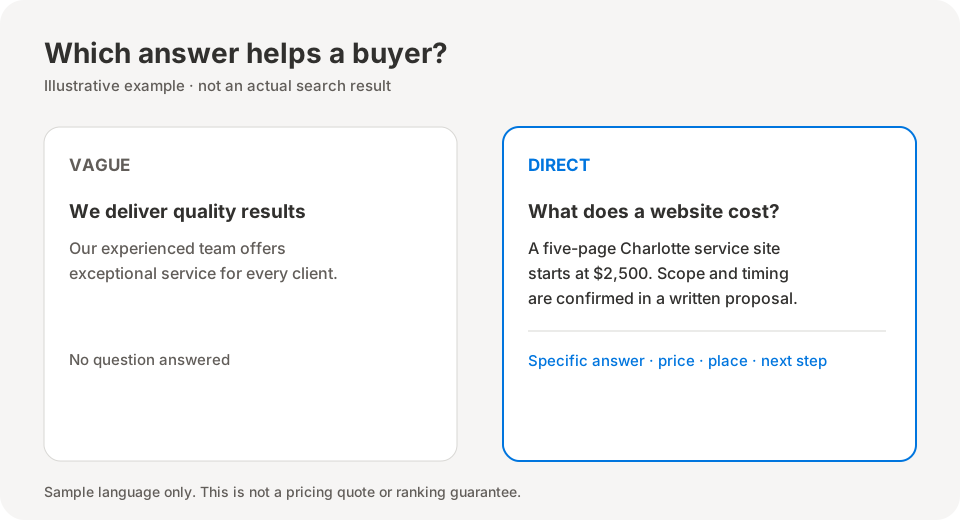
Place the answer near the relevant heading, then add detail beneath it: scope, exceptions, examples, and evidence. A terse answer without context can be misleading; a wall of introductory copy hides the answer.
A practical workflow
- Collect real questions. Start with emails, sales calls, support requests, and search queries from Search Console. Do not invent questions solely to target a keyword.
- Give each important question a home. Use a descriptive page title and a visible heading. Consolidate duplicates rather than creating near-identical thin pages.
- Answer first, qualify second. State the answer in plain language, then explain eligibility, tradeoffs, location, timing, and exceptions.
- Show your work. Add annotated screenshots, a process diagram, a concrete case study, or a source for claims that need one. Label mock examples as examples.
- Keep it current. Assign an owner to update prices, policies, hours, and service areas whenever they change.
What markup can and cannot do
Structured data can describe content that people can already see. It is not a switch that turns a page into a featured answer. Google's featured-snippet documentation says systems decide whether a page makes a good featured snippet; site owners cannot mark a page as one. Google's FAQ structured-data guidance limits FAQ rich results to eligible, authoritative government or health sites, so a small business should not promise FAQ stars or expanded results from FAQ markup.
Publish crawlable text, use headings that reflect the actual question, and keep structured data consistent with the visible page. Google's AI features guidance does not require special AI-specific markup to appear in its AI features.
How to measure it
Record a baseline before editing. Track relevant impressions and clicks in Search Console, the questions visitors ask after landing, and whether the page produces qualified inquiries. Check a small set of example queries manually, but do not treat one changing answer box as a reliable performance metric. Compare periods only after allowing for seasonality and other site changes.
The win is a page that reduces confusion and helps a buyer decide. Search visibility is a possible outcome, not a guarantee.