GEO: getting your business cited when people ask AI
More people now ask ChatGPT, Gemini, or Perplexity who to hire before they ever open Google. This page explains how those tools choose what to mention, and what a small business can do about it.
The Terms, In Plain Language
GEO (generative engine optimization) is making your business easy for AI assistants to find, understand, and cite when someone asks for a recommendation.
AEO (answer engine optimization) is structuring your pages as clear questions with direct answers, so search features like featured snippets, "People also ask" boxes, and voice assistants can quote them.
They overlap heavily. The same work helps both: clear pages, accurate facts, and content that answers a question in the first few sentences.
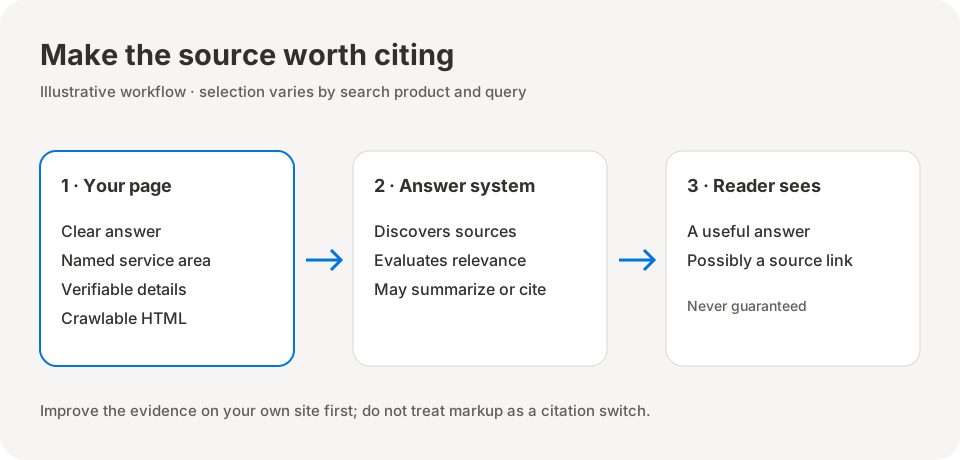
How AI tools choose what to cite
No vendor can see the exact model, and the rules change often. But the patterns are consistent enough to act on. AI answer tools tend to cite pages that:
- State the answer directly, near the top of the page
- Contain specific, checkable facts such as prices, service areas, timelines, and credentials
- Are structured with clear headings, lists, and structured data the crawler can read
- Agree with the same facts on other sites, including your Google Business Profile and directory listings
- Can be crawled at all, meaning the site does not block AI crawlers and the important text is not hidden behind scripts
Vague brand copy ("we deliver excellence") gives an AI tool nothing to quote. A page that says what you charge, where you work, and how long a job takes gives it something specific.
What to Do About It
For a typical small business site, the practical steps are the same ones I apply to my own site:
1. Answer questions first
Each service page opens with a one-paragraph direct answer, followed by the detail.
2. Make facts checkable
Publish real prices, service areas, timelines, and FAQs, with schema markup that matches the visible text.
3. Keep sources consistent
Your name, address, phone, and descriptions match across your listings, reviews, and directories.
I also publish a plain-text summary file for AI tools (llms.txt) and keep my robots file open to the major AI crawlers, so the site can be read and cited. For clients, I set both up as part of the work.
What It Costs in 2026
GEO pricing is still settling, so the honest answer is a range:
Monitoring tools that show whether AI engines mention you run about $10 to $500 per month, but they do not change your site. Managed entry-level GEO services run about $299 to $799 per month. Full-service GEO retainers run about $1,500 to $8,000 per month. (Source: ZeroGravity, "GEO Agency Pricing Guide 2026," June 2026.)
The real question is whether someone is making the changes. A monitoring dashboard without the site work usually shows little movement.
Two Ways to Work Together
Both options are fixed-price and scoped in writing before work starts. They cover search and AI search together, since the groundwork is shared. The SEO Guide covers the traditional search side in more depth.
AI Visibility Audit
- Check whether AI tools can crawl and read your key pages
- Review structured data, answer formatting, and factual consistency
- Test how your business appears for the questions your customers ask
- Prioritized list of changes, with the ones I'd make first
Monthly GEO & SEO Care
- Monthly technical checks, schema, and crawler access upkeep
- One or two pages a month written as direct answers to buyer questions
- Consistency review across listings and directories
- A short monthly report with what was tested, changed, and cited
Results in AI answers are harder to guarantee than in search, and I will not promise a specific citation count. What I can show you is what changed on the site and whether your pages are readable and accurate.
Common Questions
What is GEO?
Generative engine optimization is making your business easy for AI assistants to find and cite when someone asks for a recommendation.
What is AEO?
Answer engine optimization is structuring your content as clear questions and direct answers, so search features and voice assistants can quote it.
Can I just use a monitoring tool and skip the work?
A tool tells you whether AI engines mention you. It does not fix the pages, structure, or listings that decide whether you get mentioned. Most of the gain comes from acting on what the tool shows.
Is this different from SEO?
It shares most of the groundwork. SEO focuses on search result rankings. GEO and AEO focus on whether AI tools and answer boxes can read, trust, and quote your pages. I handle both in one plan.